Call Us +92-300-8042177

Overview
Cyber security and ethical hacking has become one of the most difficult fields in the this digital world because organizations depend on network systems. As businesses transfer data to online platforms and governments digitize important services, threats such as malware, ransomware, phishing, and advanced continuous attacks. Therefore, cyber security and ethical hacking focuses on protecting networks, systems, and sensitive information while initiatively identifying weaknesses before harmful hackers can utilize them. Rather than reacting after a crack occurs, ethical hacking focuses prevention through controlled and authorized testing of digital environments. As a result, this course at EIT Computer Institute is provide to build a strong backbone that combines theoretical knowledge with practical protection plans. Moreover, learners are focuses to real world attack models so they understand how cyber criminals think and operate. As a result, students gain the skills required to secure systems, analyze vulnerabilities, and respond effectively to cyber cases. In addition, the course aligns with international industry standards, making graduates competitive in both local and global job markets.
What You Will Learn
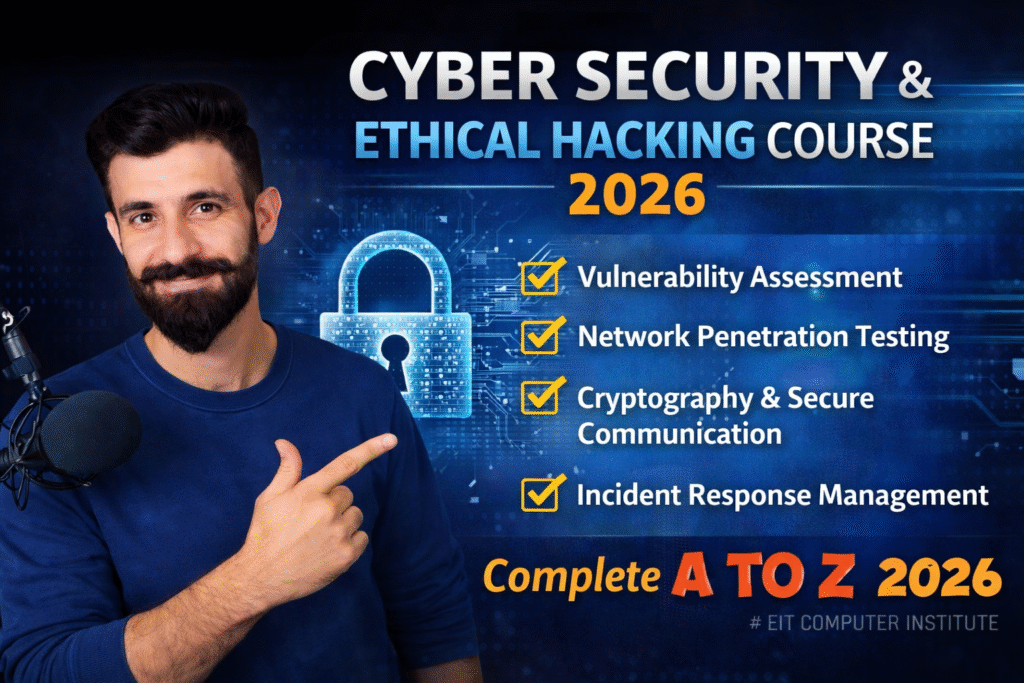
- Develops a strong understanding of computer systems, networking, and operating systems
- Explains the cyber threat environment, attack channels, and real world hacking techniques
- Provides practical training on week assessment and cracks testing tools
- Covers shielding security technologies including firewalls, IDS/IPS, and encryption protocols
- Emphasizes ethical hacking principles, legal boundaries, and compliance requirements
- Enhances analytical thinking for identifying, assessing, and prioritizing security risks
- Teaches secure system configuration and basic hardening techniques
- Builds skills for detecting, preventing, and responding to cyber attacks
- Prepares students to perform authorized security testing and assessments
- Enables learners to contribute effectively to organizational cyber resilience and security operations
Why Students Should Learn Cyber Security and Ethical Hacking
- Growing dependence on digital technology has created a massive demand for skilled cyber security professionals worldwide.
- Today, organizations suffer significant financial and reputational losses due to cyber attacks, which increases the need for trained ethical hackers. Consequently, students who learn cyber security and ethical hacking position themselves at the forefront of a high-growth career path.
- Moreover, the skills gained are transferable across industries such as banking, healthcare, education, telecommunications, and government sectors. In employment opportunities, this knowledge empowers individuals to protect their own digital identities and online activities. At once, ethical hacking nurtures problem-solving abilities and logical reasoning, which are valuable in many technical roles.
- Therefore, learning this course not only enhances career prospects but also builds digital awareness and responsibility. Ultimately, students become contributors to a safer and more secure cyberspace.
Course Content
1. Introduction to Cyber Security and Ethical Hacking
- Initially: This module introduces students to the main concepts of cyber security and ethical hacking, explaining their role in modern information systems.
- Historically: Hacking developed from investigative experimentation to advanced cybercrime operations, making ethical hacking a necessary protection. Accordingly, learners understand the difference between white-hat, black-hat, and grey-hat hackers.
- Furthermore, the this section explains how ethical hackers legally model attacks to boost security defenses. With this, students are informed with global cyber security standards and best practices.
- As a result, this foundation prepares learners for advanced technical topics in later modules.
2. Fundamentals of Networking for Security
- Networking knowledge is essential because most cyber attacks target data in data network. Therefore, this section explains how networks are designed, including LAN, WAN, and wireless architectures.
- Learners study protocols such as TCP/IP, HTTP, FTP, and DNS to understand how data flows across systems. Little by little, attention is given to common network weakness that attackers utilize.
- Meanwhile, students practice identifying insecure arrangement and weak access controls.
- As a result, participants develop the ability to analyze network traffic and recognize questionable behavior.
3. Operating Systems and System Security
- Operating systems form the backbone of all computing devices, making them prime targets for attackers.
- This Section shows the internal structure of Windows, Linux, and macOS systems.
- Further, learners understand user management, file permissions, and process control mechanisms.
- At once, common operating system cracks are discussed, including mis-arrangement and outdated solution.
- Through hands-on exercises, students practice securing systems by applying hardening techniques.
- At the end, this section provides learners with the skills to protect devices against unauthorized access.
4. Threats, Attacks, and cracks Analysis
- Cyber threats continue to developed fastly, requiring professionals to stay informed and adjustable.
- This section categorizes different types of threats such as malware, spyware, ransomware, and social engineering attacks.
- Additionally, learners study how attackers identify cracks using survey and scanning techniques. After that, vulnerability assessment methods are introduced to explain system weaknesses
- . Practical labs allow students to use scanning tools and interpret results accurately.
- Then, learners gain the ability to rank risks and recommend suitable security controls.
5. Ethical Hacking Tools and Techniques
- Ethical hacking depends on specialized tools to test system defenses effectively. So this section introduces commonly used security testing tools and frameworks.
- More, students learn how to perform footprinting, scanning, and identifying in controlled environments.
- Little by little, utilization techniques are displayed to show how cracks can be abused.
- Technical execution, ethical analysis are boosted to ensure responsible usage. As a result, learners develop hands-on expertise while maintaining professional integrity.
6. Web Application Security and Hacking
- Web applications are a primary target for cyber criminals because they process sensitive user data and financial transactions.
- This part focuses security principles for web-based systems, including the OWASP Top 10cracks.
- Students learn to identify common issues such as SQL injection, cross-site scripting (XSS), cross-site request forgery (CSRF), and insecure authentication mechanisms.
- Practical exercises provide hands-on experience in securing applications through defined doubts, input validation, and secure session management.
- At the end, learners develop the skills to assess web applications critically and implement robust protection strategies. At once, ethical analysis are boost to ensure responsible testing without causing harm to live systems.
- As a result, participants gain both defensive and offensive expertise applicable to professional environments.
7. Wireless and Mobile Security
- As wireless and mobile devices lead connectivity, securing these platforms is very important.
- This section introduces wireless security protocols such as WPA3, Bluetooth security mechanisms, and mobile operating system hardening.
- More, students examine attack vectors specific to Wi-Fi networks, including rogue access points, eavesdropping, and man-in-the-middle attacks.
- Technical analysis, learners understand mobile malware, device rooting/jail-breaking risks, and app-based cracks.
- As a result, participants acquire the ability to protect networked devices while maintaining ethical responsibility, preparing them for roles in mobile and wireless security domains.
8. Network Penetration Testing
- Security testing is the key of ethical hacking, allowing organizations to uncover weaknesses before adversaries utilize them.
- Accordingly, this lecture guides students through the security testing lifecycle: planning, investigation, scanning, exploitation, and reporting.
- Different tools, including Nmap, Metasploit, and Wireshark, are introduced for hands-on practice.
- Meanwhile, risk assessment frameworks are applied to prioritize cracks and recommend remediation.
- Students learn how to document findings effectively, producing professional reports for technical and managerial audiences.
- As a result, learners develop a comprehensive understanding of penetration testing from both technical and ethical perspectives.
9. Cryptography and Secure Communication
- Cryptography balance all secure digital communication, making it essential knowledge for cyber security professionals.
- So, this part of the course shows secure data methods, Secure storage functions, digital signatures, and public key infrastructure (PKI).
- Theoretical foundations, learners implement cryptographic techniques in real world scenarios, such as securing emails, messaging applications, and financial transactions.
- Little by little, attention is given to combining trends, including quantum-resistant algorithms and blockchain-based security solutions.
- At the end, participants gain practical skills to ensure data confidentiality, integrity, and authenticity across networks.
10. Incident Response and Cyber Security Management
- Even with tough defenses, security hacks may occur, making incident response a critical skill.
- This Section teaches students how to detect, analyze, and respond to cyber incidents efficiently.
- Frameworks like NIST, ISO 27001, and SANS are discussed to align response procedures with international standards.
- Moreover, learners study forensic investigation techniques, including log analysis, malware reverse engineering, and chain-of-custody management.
- At once, risk management principles guide the prioritization of threats and allocation of resources.
- As a result, graduates are capable of both preventing attacks and managing security events effectively, strengthening organizational strength.
What you will become after this course
- Skilled Cyber Security & Ethical Hacking Professional
- Expert in Vulnerability Assessment and Security Testing
- Capable of Handling Incident Response and Threat Mitigation
- Proficient in Securing Networks, Systems, and Web Applications
- Specialized in Mobile and Online Platform Security
- Strong Ethical, Legal, and Professional Decision-Making Skills
- Ready for Corporate and Government Cybersecurity Roles
Career Growth and Opportunities in Cyber Security
- Rapidly Growing Cyber Security Industry
- High Demand Across Multiple Sectors (Finance, Healthcare, Government, Defense)
- Increasing Need for Ethical Hackers
- Access to High-Paying and Responsible Roles
- Diverse Career Opportunities Worldwide
- Strong Long-Term Career Growth and Advancement
Global Standards and Compliance in Cyber Security
Conformity with global standards ensures organizations meet legal and operational requirements.
This Section introduces frameworks such as GDPR, ISO 27001, NIST, and PCI-DSS.
Students learn how to implement security policies and maintain compliance across various environments.
At the end, learners become valuable assets to organizations seeking regulatory adherence and operational integrity.
Practical Labs and Real-World Model
- Hands-on experience through controlled lab environments
- Simulate attacks and analyze system vulnerabilities
- Implement defensive measures to strengthen security
- Enhances technical proficiency, confidence, and problem-solving skills
- Prepares students for real-world security challenges
Building a Cyber Security Mindset
- Develop strategic thinking and proactive risk assessment
- Emphasize ethical decision-making
- Cultivate vigilance and analytical approach to threats
- Enables anticipation of attacks and effective response
- Shapes learners into skilled practitioners and strategic thinkers
In today’s digitally international network world, cyber threats are inevitable, making cyber security and ethical hacking an essential skill set.
EIT Computer Institute’s course provide students with foundational knowledge, practical skills, and ethical understanding, enabling them to secure systems, analyze vulnerabilities, and respond to incidents effectively.
By combining theoretical learning with hands-on simulations, learners graduate as confident, job-ready professionals. Moreover, the course focuses real-world application, global standards, and career growth, ensuring that graduates thrive in an evolving digital landscape.
At the end, students who complete this program not only protect information and technology but also contribute to a safer, more strength cyberspace.
Should you have any questions, our official website provides complete information.
Ready to begin your learning journey? Enroll now by clicking here